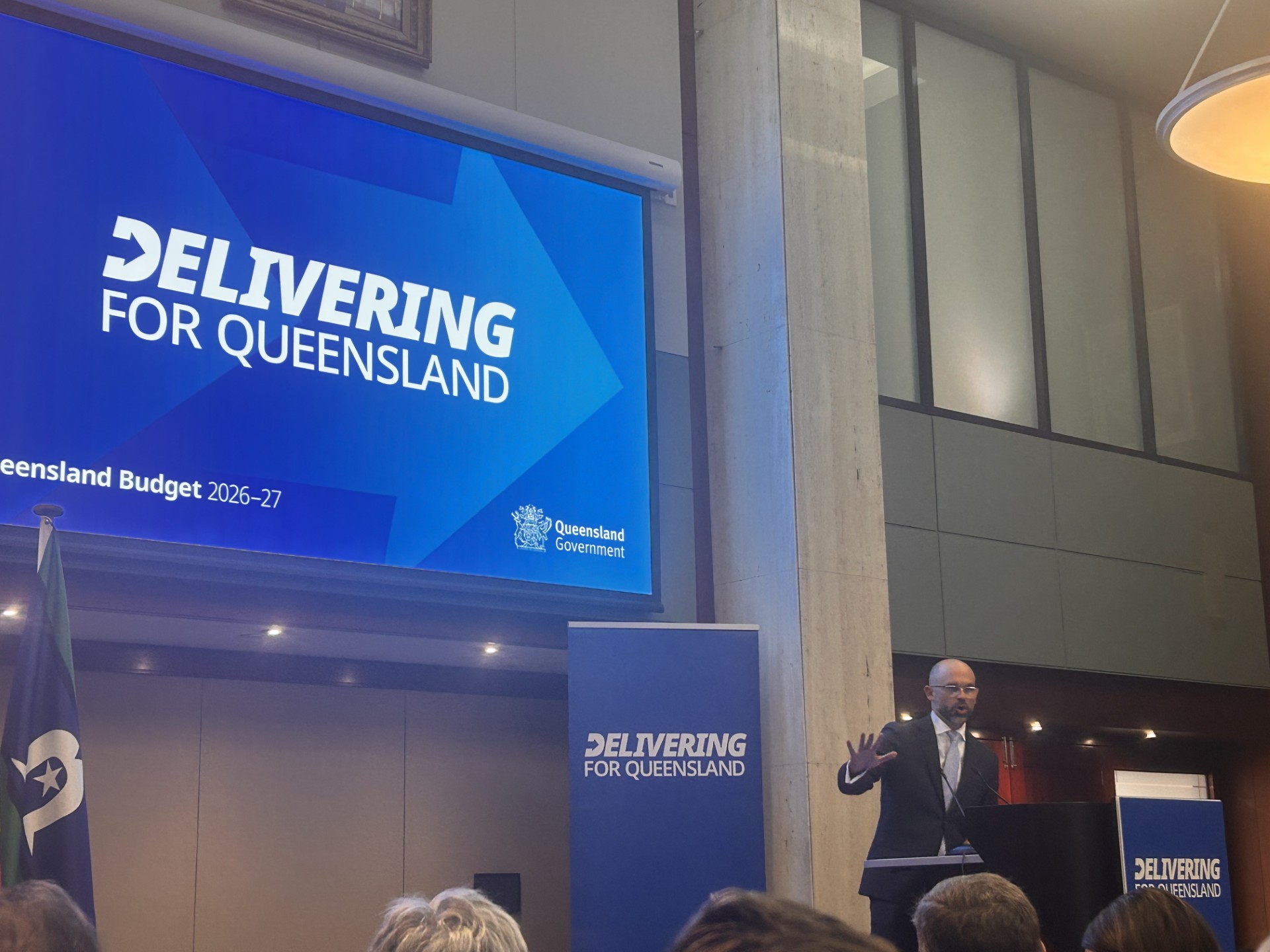
A week on from Budget night, and following IAQ’s session with the Treasurer, the Hon Dr Jim Chalmers, the 2026-27 Federal Budget is coming into sharper focus for the Queensland infrastructure sector. The Treasurer framed it as a Budget of resilience, relief and reform.
Dr Chalmers characterised the global economic environment as having moved from a period of irregular shocks to one of constant shocks, with global uncertainty now flagged through the Budget and forward estimates. Against that backdrop, continued investment in the infrastructure pipeline is positioned as a stabilising force for the economy, protecting productive capacity while supporting long-term growth, housing supply and the Brisbane 2032 Olympic and Paralympic Games.
For Queensland, the headline portfolio figure remains $12.1 billion in new investment across the Infrastructure, Transport, Regional Development, Communications, Sport and the Arts portfolio, including $10.3 billion in new transport infrastructure commitments nationally. Within that envelope, several major Queensland projects are funded forward, and a range of national-scale programs will flow material work into the state.
QUEENSLAND INFRASTRUCTURE HIGHLIGHTS
- $812.5 million for Stage 2 of the Bruce Highway upgrade (Gateway Motorway to Dohles Rocks Road) building on $758.4 million committed in Stage 1, and forming the next tranche of the broader $9 billion 80:20 Commonwealth-State Bruce Highway Safety and Resilience Program.
- An additional $1.15 billion for the Direct Sunshine Coast Rail Line (Beerwah to Caloundra, Stage 1), taking the Commonwealth contribution to $2.75 billion and matched by the Queensland Government, with main construction sequenced through the back half of the decade.
- Confirmation of the $3.435 billion Commonwealth contribution to the $7.1 billion Brisbane 2032 Games Venue Infrastructure Program, with allocations now refined: up to $1.2 billion to the main stadium, up to $1.651 billion to the Games Venues Program, and $584 million still to be apportioned.
- 80 per cent (approximately $2.9 billion) of the 2026-27 Financial Assistance Grants brought forward to local government, providing earlier liquidity for council-delivered roads, water and community infrastructure across regional Queensland.
- Continued contributions to the national $1.75 billion Freight Rail Productivity Program, $1.1 billion Cleaner Fuels Program and a further $500 million for the Active Transport Fund, each of which carries Queensland work packages.
WORKFORCE AND SKILLS
The Budget also responds to the issue of workforce. Construction Skills Queensland estimates the state’s construction worker shortage will peak at approximately 50,000 workers in 2026-27. The Commonwealth has confirmed:
- The permanent migration program will remain capped at 185,000 places, with more than 70 per cent reserved for skilled migrants.
- $85.2 million for faster skills assessments and accelerated occupational licensing for migrant trades workers projected to support up to an additional 4,000 skilled trades workers each year.
These measures are constructive, but the scale of the Queensland shortfall means workforce capacity will remain the defining constraint on delivery timeframes through this decade. IAQ continues to advocate for a coordinated workforce strategy that links migration settings, domestic training pipelines and project sequencing.
PRODUCTIVITY AND REFORM
In his post-Budget remarks, Dr Chalmers placed particular weight on the Budget’s productivity package, describing it as an effort to strengthen the “green shoots” of productivity now emerging across the economy. The package was heavily informed by the Government’s reform roundtable process and is structured around four interlocking objectives:
- Making it easier and quicker to build.
- Making Australia a more attractive destination for investment.
- Decreasing compliance costs and red tape across the delivery system.
- Improving the efficiency of government itself as a client and approver.
For the Queensland infrastructure sector, the “easier and quicker to build” objective is the one to watch. Streamlined approvals, consistent national settings and reduced compliance burden are issues IAQ has consistently raised through its advocacy on productivity.
The Treasurer was candid that elements of the productivity and reform agenda will be contested, and noted the Government has shifted its position on aspects of housing and structural reform where earlier approaches were not delivering the intended outcomes.
HOUSING, REGIONS AND ENERGY
The Budget maintains existing settings under the Housing Australia Future Fund and the National Housing Accord targets, with no major new structural reform announced. Regional Australia continues to be supported through the Growing Regions and Precincts and Partnerships Programs. Energy transition spending remains anchored to the $20 billion Rewiring the Nation envelope and existing renewable energy zone agreements, both of which will have Queensland delivery components.
WHAT THIS MEANS FOR THE QUEENSLAND SECTOR
The 2026-27 Federal Budget reinforces (rather than expands) the Queensland infrastructure pipeline. Members can expect: stronger near-term visibility on Bruce Highway and Direct Sunshine Coast Rail work packages; continued momentum on Brisbane 2032 venue planning, now with refined funding allocations; and more predictable funding flows to local government clients. Workforce remains the binding constraint, and project sequencing will be the determining factor in how much of this pipeline can be delivered on time and on budget.
IAQ welcomes ongoing consultation with the Commonwealth, the Queensland Government and Infrastructure Australia on prioritisation, project staging and workforce settings. The Association will continue to engage with members throughout the year ahead to ensure the sector’s perspective is reflected in delivery decisions for the state.